Getting admitted is the exciting part. What trips students up is underestimating how long the visa process itself takes once admission is confirmed, particularly the interview wait time at the US Embassy in Accra, which fluctuates and has historically run into several months during busy seasons. Here is a full, stage-by-stage timeline so you can plan backwards from your program start date with realistic expectations at every step.
Stage 1: Receive Your I-20 (Week 0)
Your school issues your I-20 once you've confirmed admission and shown proof of funding. This document carries your SEVIS ID number, which you need for every step that follows. Nothing else in the visa process can start until this is in hand, so if your I-20 is delayed, everything downstream shifts with it. Follow up with your school's international office promptly if it hasn't arrived within the timeframe they've quoted.
Stage 2: Pay Your SEVIS Fee (Week 0 to 1)
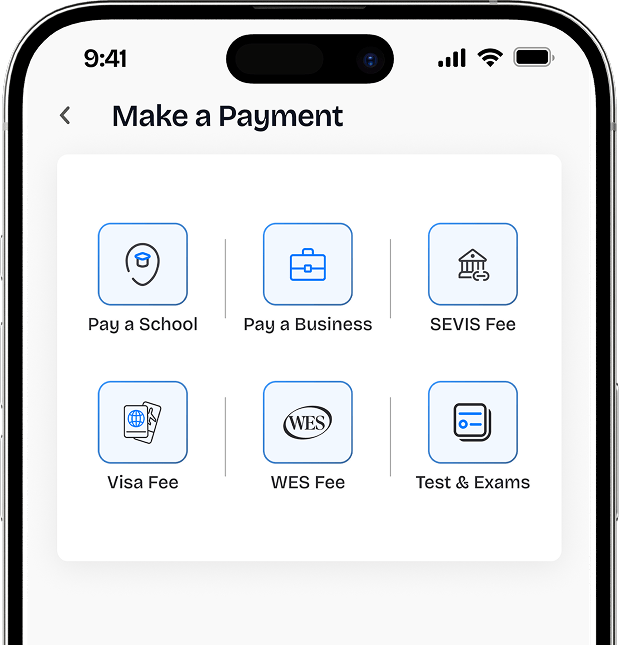
As a Ghanaian applicant, the easiest and fastest way is to use the Radius App, since credit card payments are not available on FMJfee.com. It takes between 1-24 hours to complete your payment with Radius. Using a platform built for this exact corridor, such as Radius, means you're not losing days to forex bureau comparison shopping or an unreliable agent before you can even begin the official payment.
What the SEVIS Fee Actually Is
The I-901 SEVIS fee is a US government charge that activates your record in the Student and Exchange Visitor Information System, the database DHS uses to track F, M, and J visa holders throughout their time in the United States. It is separate from your school's tuition and fees and from the visa application fee you pay at the embassy. It goes directly to DHS, and your visa interview cannot proceed until it shows as paid and processed on your record.
For F-1 and M-1 students, the fee is 350 US dollars. For most J-1 exchange visitors, it is 220 dollars, and for J-1 Au Pair, Camp Counsellor, and Summer Work Travel participants, it drops to 35 dollars. Dependents on F-2, M-2, or J-2 visas do not pay this fee.
Who Needs to Pay It
· Every prospective F-1 or M-1 student issued an initial "Initial Attendance" I-20
· Prospective J-1 exchange visitors issued an initial DS-2019, except those on federally sponsored programs with codes starting G-1, G-2, G-3, or G-7
· Anyone in the US applying for a change of status into F, M, or J classification
· Students readmitted after being out of status for more than five months.
You generally do not have to pay again if you are transferring schools under the same SEVIS ID, extending your program, or returning from an absence of less than 5 months.
Step-by-Step: Paying Your SEVIS Fee from Ghana
1. Have your I-20 in hand. You need your exact SEVIS ID (it starts with N), your name exactly as printed on the I-20, your date of birth, and your school code. Do not attempt this from memory.
2. Go to FMJfee.com. This is the only official DHS portal for this payment. Any other site, agent, or WhatsApp group offering to "process" your SEVIS fee for a service charge should be treated as a scam, since FMJfee.com explicitly states that no third party is authorised to charge an extra fee for this.
3. Fill in the I-901 form exactly as your I-20 shows it. A mismatched name, even a small spelling difference or a missing middle name, is one of the most common causes of payment errors that then require a manual correction request through FMJfee.com, which adds days or weeks.
4. Download your SEVIS fees coupon. You need to download the SEVIS fees coupon and visit the Radius App...
5. Complete your SEVIS fees payment on the Radius App. Radius allows you to seamlessly pay your SEVIS fee directly from Nigeria, bypassing strict central bank forex limits. Transactions are typically processed in under 10 to 30 minutes, and the app is available on both the Google Play Store and Apple App Store.
Here is how you can use the app to process your payment:
1. Download the Pay4Me App and create an account.
2. Navigate to the payment options and select SEVIS Fee.
3. Input the required payment details and instructions.
4. Pay the equivalent amount in Cedis via bank transfer or your preferred method within the app.
5. Receive an instant confirmation email.
Common Mistakes to Avoid
· Waiting until a week before the interview. Western Union and money order payments take longer to reflect than card payments, so give yourself a buffer of 5 to 7 business days.
· Entering your name with a nickname or a spelling that does not exactly match your I-20 or passport.
· Paying against the wrong SEVIS ID number, which happens when students reuse an old ID from a previous school or a rejected admission.
· Assuming a school agent or partner has already paid on your behalf without confirming directly with your Designated School Official.
· Using an unofficial site or agent that charges a "processing fee" on top of the real SEVIS fee. FMJfee.com is free to use directly.
· Converting cedis to dollars at a poor rate right before payment, which can quietly add the equivalent of an extra 20 to 50 dollars to what should be a fixed 350-dollar fee.
Stage 3: Complete the DS-160 Form (Week 1 to 2)
This is the online nonimmigrant visa application. It asks for detailed background, travel, family, and program information, and you'll need a passport-style photo meeting strict specifications regarding background colour, head position, and file format. Take your time here. Errors, inconsistencies, or answers that don't match your other documents can trigger additional scrutiny later in the process, sometimes resulting in administrative processing after the interview.
Stage 4: Pay the Visa Application (MRV) Fee and Schedule Your Interview
The MRV fee is separate from the SEVIS fee and is paid to schedule your interview appointment at the embassy. Only book your interview slot once your SEVIS payment has actually processed and shows as confirmed on FMJfee.com, not just submitted, since scheduling before confirmation is one of the most common causes of a wasted appointment.
Stage 5: Wait for Your Interview Slot
This is the stage that varies the most, and the one most students underestimate. Wait times at the US Embassy in Accra for interview appointments have ranged from a few weeks to well over two months depending on the season, with the run-up to the US fall intake typically being the busiest period of the year. Check the US State Department's live wait time tool close to when you're ready to book, since this number changes regularly and should never be assumed from an old article, including this one.
If your situation is genuinely urgent, such as a program start date that falls before the standard wait time would allow, emergency appointment requests exist, though they require meeting the embassy's stated urgency criteria and are not guaranteed.
Note: When you pay your SEVIS fees with Radius, you get complimentary mock visa sessions to help you prepare.
Stage 6: Prepare Your Documentation
While you wait for your interview date, use the time productively. You'll typically need:
· Valid passport, with at least six months' validity beyond your intended stay
· I-20, signed
· SEVIS fee payment receipt
· DS-160 confirmation page with barcode
· Admission or acceptance letter
· Financial documentation showing your ability to fund at least the first year of study
· Academic transcripts and standardised test results, if requested
· Passport photo meeting the specified format
Organise these in the order the consular officer is likely to ask for them, rather than scrambling through a folder on interview day.
Stage 7: Attend the Interview
Bring every document listed above in person, even if you've already uploaded digital copies elsewhere. The consular officer will check your SEVIS record electronically, and if your fee hasn't been processed, the interview cannot proceed. This is why the timing in Stage 2 matters as much as it does; a well-prepared file means nothing if the SEVIS payment itself isn't confirmed.
Interviews for F-1 and J-1 applicants are typically brief, often under ten minutes, and focus on your intent to study, your ties to Ghana, and your ability to fund your education.
Stage 8: Visa Processing After the Interview
Most F-1 and J-1 visas approved on the spot are processed and returned with the passport within about a week, though some cases enter administrative processing under Section 221(g), which can add anywhere from a few weeks to, in less common cases, several months. If this happens, the embassy will typically tell you what additional information or documentation is needed.
Realistic Total Timeline
Putting the stages together, most Ghanaian students should plan for three to six months from receiving their I-20 to having a visa in hand, with the interview wait time being the single biggest variable. If your program starts in August or September, starting this process in February or March gives you meaningful breathing room rather than racing against the calendar.
A Timeline Summary Table
|
Stage |
Typical duration |
Key risk if delayed |
|
I-20 issued |
Week 0 |
Everything downstream shifts |
|
SEVIS fee paid and processed |
Week 0 to 1 |
Cannot schedule interview |
|
DS-160 completed |
Week 1 to 2 |
Errors trigger extra scrutiny |
|
Interview scheduled |
After SEVIS confirmed |
Booking too early wastes the slot |
|
Interview wait time |
Weeks to a few months, season-dependent |
Largest source of overall delay |
|
Interview and decision |
1 day |
N/A |
|
Passport processing |
Up to 1 week (longer if 221g) |
Delays travel booking |
Where Delays Usually Happen
· Waiting too long after receiving the I-20 to pay the SEVIS fee
· Scheduling the interview before the SEVIS payment has actually processed
· DS-160 errors or inconsistencies that trigger extra review
· Underestimating currency conversion time and cost when sourcing dollars for the SEVIS and MRV fees
· Missing or disorganised documents at the interview itself
· Not checking live interview wait times before planning a program start date.
Frequently Asked Questions
How far in advance should I start the visa process? As soon as you have your I-20, ideally four to six months before your program start date, given how much the Accra interview wait time can shift.
Can I speed up the interview wait time? Emergency appointments are available for specific circumstances, such as an imminent program start date, but they are not guaranteed and require meeting the embassy's stated criteria for urgency.
Does paying the SEVIS fee early guarantee an earlier interview slot? No, the SEVIS fee and interview scheduling are separate systems. Paying early just makes sure you're not blocked once a slot becomes available, and it protects you from the risk of a delayed Western Union or money order payment that could hold up your booking.
What's the fastest realistic timeline if everything goes smoothly? Under ideal conditions, with a quick I-20, immediate SEVIS payment, a clean DS-160, and a short interview wait, the whole process can complete in as little as six to eight weeks. This is the exception rather than the rule, so plan for the longer end of the range.
How can I pay my SEVIS fee in Ghana? The Radius App has made it easier for you to pay in Cedis within 10 minutes. It takes 1-24 hours to complete this transaction.