Every Nigerian family sending a child abroad knows that fees can increase if they don’t act quickly. Many without domiciliary accounts or the privilege of storing foreign currencies would convert the local currency into pounds, euros, or dollars. Between the day the offer letter arrives and the day the transfer clears, the same fee can cost hundreds of thousands of naira more.
Imagine 150,000 to 200,000 families experiencing this and paying the extra amounts at once. The calculation leads you to one of the largest, least-examined outflows in the Nigerian economy.
The Central Bank's own balance-of-payments data puts a number on it: Foreign education cost Nigeria $28.65 billion from 2010 to 2020, with Personal Transport Allowance (PTA) totalling $58.7 billion. Despite the high exchange rate and an inflation-induced cost-of-living crisis across the country, Nigerians' spending on foreign education rose between 2021 and 2025. Nigerians increased spending on foreign education and health services by 19 per cent to $1.73 billion in the first half of 2025, the highest in four years, since 2022.
The amount spent by Nigerians between 2020 and the first half of 2025 equals around 2.6% of Nigeria’s annual nominal GDP. To bring this fact home, in 2025, the country allocated N2.52 trillion to education. This accounts for about 5% of total spending and is below the UNESCO-recommended 15–20%. Interestingly, a number of Nigerians spent nearly the same amount on foreign education in the first six months of 2025.
In 2026, Nigeria’s total public expenditure on education stands at approximately ₦9.49 trillion against a projected nominal Gross Domestic Product (GDP) of ₦442.8 trillion, representing just 2.14 per cent of national output and still falling significantly below international benchmarks,
While countries continue to tighten their borders with stricter rules, it has not stopped Nigerian families from sending their members abroad. In 2026, Nigeria ranked as the third-largest country worldwide for sending its citizens to pursue higher education abroad, according to a UNESCO report.
Research from the World Education Services (WES) reports that outbound student mobility from Nigeria quadrupled over two decades, reaching nearly 85,000 by 2021. Nigerian enrolments in the US grew by 56% to more than 23,000 by 2024, while enrolments in Canada surged by 260% between 2021 and 2023, reaching approximately 46,000 students. Nigerian students now represent the single largest African contingent in both US and UK institutions. This is the largest, fastest-growing outbound education market in Sub-Saharan Africa.
A currency that won't hold still
Start with the exchange rate, because every other friction compounds on top of it. The naira has lost roughly 90 per cent of its value against the dollar since 2010, when a dollar bought about 150 naira. Today it takes somewhere between 1,350 and 1,430. The 2023 unification of exchange-rate windows alone took the naira from about 470 to the dollar to nearly 1,700 within eighteen months, before it partially stabilised through 2025 and into 2026.
This is not an abstract macro statistic. It means a fee that cost 15 million naira at admission can cost 18 million by the first instalment, with the dollar-denominated tuition never moving at all. Families aren't budgeting for a degree, but underwriting a currency bet they never chose to make, with no forward contract, no hedge, and no institution offering them one. Exchange rates can fundamentally change affordability across different markets.
When the Rules Move Faster Than the Money
If currency volatility were the only obstacle students face, this would already be hard enough. But the regulatory ceiling on how much foreign exchange a student can legally access has itself been in near-constant motion.
For international student payments, regulatory generosity and regulatory predictability are not the same thing. A higher remittance ceiling may increase the amount a student is permitted to pay, but it does not necessarily increase the likelihood that the payment will reach the institution before its deadline. The operational problem emerges when the rules governing a transaction change faster than the financial infrastructure required to interpret, document, process and settle that transaction.
This creates a distinctive mismatch. University payment deadlines are fixed, while the regulatory and operational environment through which families move money can change between admission and payment. A student may therefore have sufficient funds in naira and may even be legally permitted to remit the required amount, but still face a delay because banks, payment providers, documentation processes, and institutional requirements do not move at the same pace.
This is why regulatory change should be evaluated not only by how much money it permits students to move, but also by how predictably and quickly that money can move through the system. A policy can be technically more generous and still be operationally difficult if compliance requirements, processing capacity and settlement timelines lag behind the student's payment deadline.
Each of these adjustments, read individually, looks like an improvement, and in isolation it is. But a family that structures a four-year financing plan around today's rules has no way of knowing what the rules will be at the next payment date. Currency risk is at least a known unknown; families can watch the naira and plan around a range. Policy risk is different: it moves at the discretion of a regulator responding to reserve pressure, and no household budgeting spreadsheet can reliably price it in.
The paperwork compounds it. A remittance through an authorized bank requires a Form 'A', an admission letter, a tuition fee schedule in a specific format, a valid passport, and a student ID for returning students. Each requirement is a place the process can stall. For instance, a bank officer unfamiliar with the form, a university slow to issue documentation Nigerian regulators will accept, a passport stuck in a renewal backlog. None of these is dramatic alone. Together, they routinely stretch a transfer that should take a day into one that takes weeks, sometimes past the university's own payment deadline.
When the system fails, students absorb the cost directly
This isn't theoretical. Nigerian scholars under the government's Bilateral Education Agreement scheme told reporters in late 2025 that they had gone almost three years without stipends. Some described being unable to afford food or rent. Parents linked the death of one scholar, studying in Morocco, to the prolonged financial neglect. That case involves government-administered scholarships rather than private remittances, but it demonstrates the pattern precisely: when the formal system for moving money slows or breaks, the student bears the damage directly, usually far from any support network that could intervene.
For privately financed students, the failure mode is quieter but far more common. A payment that misses a deadline because processing took too long triggers late fees and sometimes visa complications tied to a university's sponsorship status. Financial friction doesn't sit beside the study-abroad experience. It determines who gets to have it, and when. This is what researchers in international education finance call friction-driven attrition: qualified, admitted students who withdraw or defer because the money simply couldn't move fast enough.
The Parallel Market—and the Case for Better Formal Alternatives
Because the official channel can be capped and slow, a meaningful share of study-abroad financing still moves through informal routes. Some of the routes include parallel-market currency purchases, domiciliary account transfers and money routed through relatives abroad. The 2026 FX Manual acknowledged part of this reality by allowing self-funded domiciliary account holders to send up to $10,000 per day and removing the Form 'A' requirement for those accounts.
However, it also reveals the scale of the underlying problem: when formal channels are difficult to navigate, people find alternatives. Parallel-market rates typically run above the official rate. This means families who cannot obtain enough foreign currency through formal channels pay a premium for the identical degree. That premium falls unevenly. Wealthier families with existing domiciliary accounts and established banking relationships can absorb the additional cost and administrative burden. Middle- and lower-income families, for whom a foreign degree may be the single largest investment they will ever make, are more likely to bear the brunt of a worse exchange rate, processing uncertainty, and additional risk.
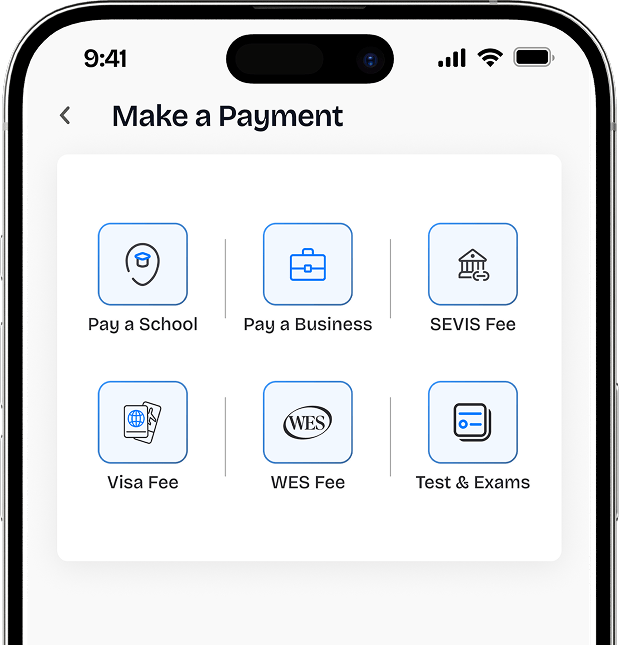
This is where regulated fintechs can play an important role. The opportunity is not to replace banks or circumvent foreign-exchange regulation, but to build the operational infrastructure that makes compliant international education payments faster, more transparent and easier to execute. Licensed cross-border payment platforms can aggregate documentation requirements, provide clearer transaction workflows, connect payment processes more directly to overseas institutions and give families greater visibility over where a payment sits in the process. Where these systems are properly integrated with regulated financial institutions, they can reduce the number of points at which a transaction can stall without weakening the regulatory controls around it.
The significance of this goes beyond convenience. A student who has already secured admission should not have to choose between paying a parallel-market premium and risking a university deadline because the formal payment process is too slow. If regulated financial technology can compress a compliant payment from weeks to days, the formal channel becomes more competitive with the informal one because the infrastructure for compliance has improved.
Fintech, therefore, should be understood as part of the infrastructure connecting Nigerian families to the global education system. Its value lies not merely in moving money across borders, but in reducing the financial and operational friction between an admission decision and a successfully settled tuition payment.
Conclusion
Nigeria’s international student mobility has outgrown the financial infrastructure supporting it. Families continue to invest in overseas education despite currency volatility, regulatory uncertainty and complex payment processes. The challenge is whether the financial system can move their money as reliably as their educational ambitions.
The evidence suggests that reform must go beyond increasing foreign-exchange limits. Money must move at the speed of the obligation it is meant to meet. Stable remittance rules, regulated payment corridors between Nigerian financial institutions and overseas universities, and appropriate education-financing mechanisms can reduce the uncertainty families currently absorb.
Regulated fintechs can complement this infrastructure by simplifying documentation, improving transaction visibility and reducing settlement delays without weakening compliance.
Ultimately, access to international education should not depend on whether a family can navigate an unpredictable payment system. The goal should be a financial ecosystem in which compliant, affordable, and timely payments make international education more predictable, inclusive, and accessible.